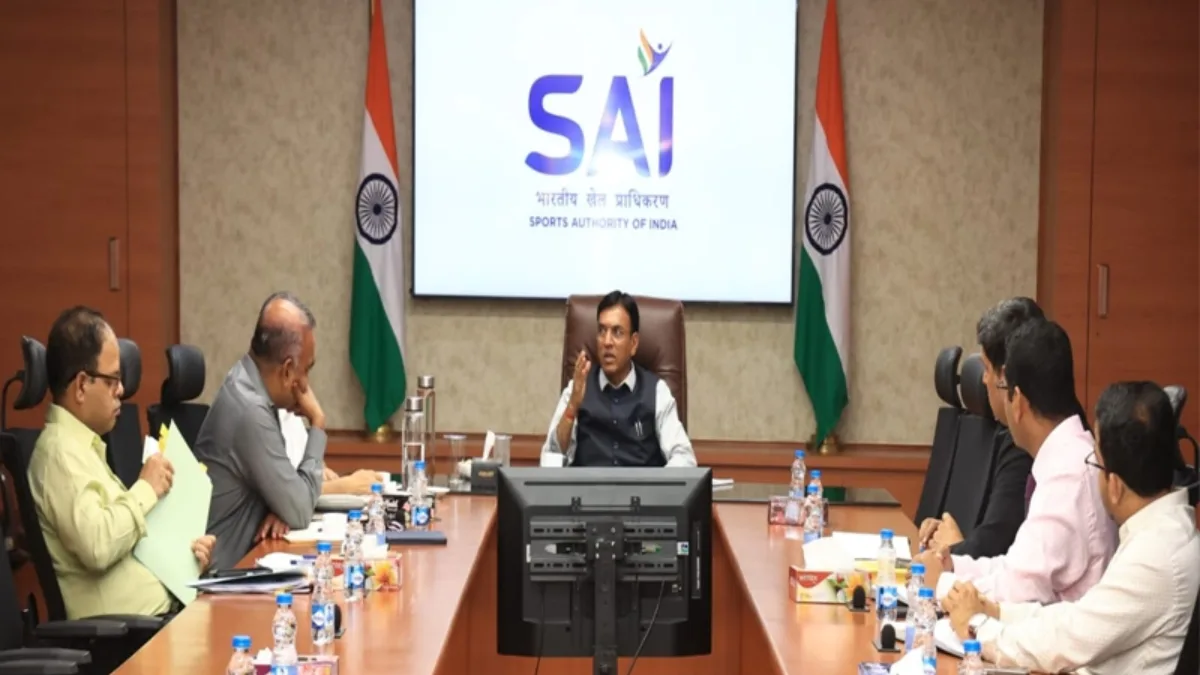
Union Minister for Youth Affairs and Sports Mansukh Mandaviya on Thursday chaired a high-level review meeting at the Sports Authority of India (SAI) headquarters to assess India’s preparations for the 2026 Asian Games in Japan.
The continental multi-sport event is scheduled to be held from September 19 to October 4 in Aichi-Nagoya, with more than 700 Indian athletes expected to compete across over 40 sports disciplines.
Advertisement
During the meeting, Mandaviya reaffirmed the government’s commitment to athlete welfare and performance, stressing that athletes would receive comprehensive support to help them focus solely on their preparation.
“Our athletes are our top priority. Every possible support, from training and sports science to logistics, kit support, food support and medical care, will be provided so that they can prepare without distractions and deliver their best at the Asian Games,” he said.
“Our aim is not to make them suffer at any cost and ensure they remain focused on increasing our medal tally at the competition,” Mandaviya added.
Senior officials from the Ministry of Youth Affairs and Sports, SAI and other stakeholders briefed the minister on the country’s readiness ahead of the Games.
A 15-member committee constituted to oversee preparations has already held four meetings since December 2025 to streamline planning across training, logistics, athlete welfare and competition readiness. The panel includes Hari Ranjan Rao, Secretary of the Ministry of Youth Affairs and Sports; P. T. Usha, President of the Indian Olympic Association; Sahdev Yadav, Asian Games Chef de Mission; and Sharath Kamal, Deputy Chef de Mission.
The next committee meeting is scheduled for March 20, where final discussions on the size of the contingent, travel plans and operational readiness will be taken up as India enters the decisive phase of preparations.
Mandaviya also emphasised the importance of coordination among stakeholders, noting that structured planning and strong support systems would be crucial in helping India achieve new milestones at the Games.
As part of the preparation process, each National Sports Federation has appointed a nodal officer to study the Asian Games Technical Handbook and brief athletes, coaches and support staff on discipline-specific requirements.
Teams will be finalised well in advance to allow athletes sufficient time for focused preparation. Efforts are also underway to strengthen support staff capacity, particularly medical teams, while coordination with Indian embassies abroad will be enhanced to facilitate logistics.
Sports federations have been given flexibility to plan exposure tours and competition schedules. For disciplines requiring complex operational planning, support will be organised across multiple locations with dedicated staff deployed at each venue.
Officials are also paying special attention to acclimatisation factors such as food and environmental conditions. Measures are being explored to simulate competition environments in India ahead of the Games.
India’s target is to surpass the historic 106-medal haul achieved at the 2022 Asian Games in Hangzhou through strategic preparation and coordinated efforts.
The Aichi–Nagoya Asian Games will follow a unique five-cluster competition model, with events spread across multiple prefectures rather than a single Olympic village-style setup. Venues will be located across clusters, including Aichi, Gifu, Shizuoka and the Airport-Expo zone, requiring detailed planning for travel, logistics, medical support and athlete recovery.
To help athletes adapt to the Games’ accommodation conditions, makeshift container-style housing units will be installed at SAI regional centres in Patiala and Bengaluru. Officials said the initiative would allow athletes to familiarise themselves with the living arrangements expected during the Games.
Mandaviya also reviewed the findings of a four-day recce visit by an Indian Olympic Association delegation in January, which inspected key competition venues, athlete facilities and logistics infrastructure in Japan.
Based on the assessment, cluster-wise planning is now being implemented with dedicated logistics officers, medical teams and support staff assigned to each competition zone to ensure seamless operations for Indian athletes.